
Discover Vienne | A Visitor's Introduction to Vienne
Recommended places to visit, places to stay and things to do in Vienne
Vienne is a captivating department in South West France, located in the Poitou-Charentes region. Named after the Vienne River, which flows gently through its countryside, this historically rich and naturally beautiful area is known for its Romanesque architecture, fascinating prehistoric sites, and a mix of vibrant towns and quiet, rural villages. Vienne offers a rewarding blend of culture, nature, family-friendly attractions, and relaxed French charm.
From the futuristic theme park of Futuroscope to ancient abbeys and castles, Vienne is perfect for families, history enthusiasts, outdoor adventurers, and those looking to explore an authentic slice of inland France.
Recommended Vienne Accommodation: Hotels
Why is Vienne Worth a Visit?
Vienne is worth visiting for its remarkable variety. Within a relatively compact area, you’ll find one of Europe’s leading science and multimedia parks, sleepy stone villages with Romanesque churches, the legacies of Eleanor of Aquitaine and the Plantagenets, prehistoric cave art, and stunning river valleys perfect for canoeing or cycling.
The department’s capital, Poitiers, is a vibrant university city with a rich medieval heritage, while the surrounding countryside is dotted with fortresses, abbeys, and troglodytic dwellings carved into rock faces. Despite all this, Vienne remains wonderfully uncrowded and down-to-earth.
Whether you’re gliding through time at Futuroscope, wandering through a Romanesque cloister, or enjoying a picnic beside the Vienne River, this is a destination that combines history and modernity with grace and ease.
Vienne Highlights: Things to See and Do in Vienne
Poitiers
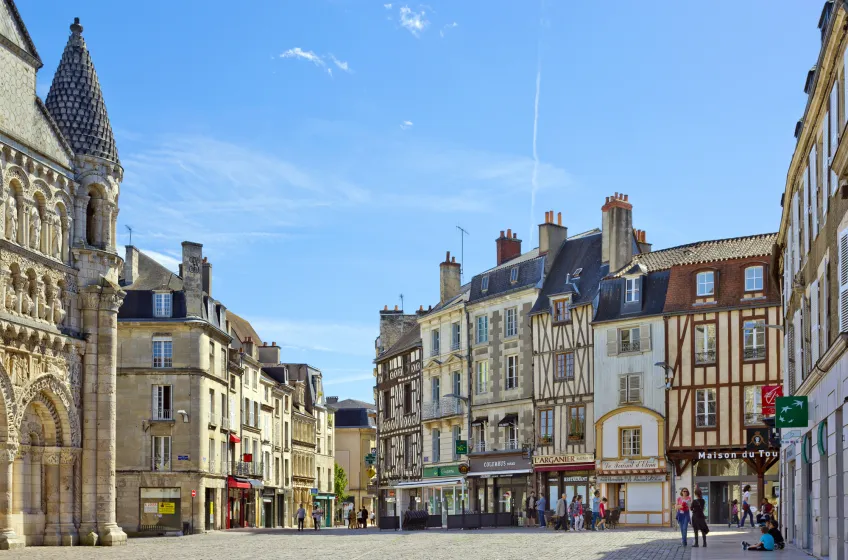
The capital of Vienne, Poitiers is a lively and attractive hilltop city with a wealth of historical treasures. Known as the “City of a Hundred Bell Towers”, Poitiers was a key stronghold of the Plantagenet dynasty and has a fascinating mix of Romanesque, Gothic, and Renaissance architecture.
Don’t miss:
-
Église Notre-Dame-la-Grande: A Romanesque masterpiece with a stunning sculpted façade.
-
Baptistère Saint-Jean: One of the oldest Christian buildings in France, dating to the 4th century.
-
Palais des Comtes de Poitou-Ducs d’Aquitaine: A former palace now housing the courthouse, with an impressive Gothic hall built by Eleanor of Aquitaine.
Poitiers also has a youthful vibe thanks to its student population, with plenty of cafés, markets, and live music events. The historic centre is compact and pedestrian-friendly, making it perfect for a walking tour.
Futuroscope
Located just north of Poitiers in Chasseneuil-du-Poitou, Futuroscope is one of France’s most popular theme parks—and it’s like no other. Blending science, multimedia, and technology with immersive entertainment, the park offers 4D cinemas, virtual reality rides, interactive exhibits, and stunning live shows.
Highlights include:
-
“The Time Machine”: A hilarious journey with the Minions through key moments in history.
-
“Objective Mars”: A thrilling space mission rollercoaster.
-
Evening light and sound shows: Spectacular family-friendly performances set over water.
Futuroscope appeals to all ages and is especially ideal for families with children aged 7 and up. Stay overnight in one of the park’s themed hotels for the full experience.
Abbey of Saint-Savin-sur-Gartempe
A UNESCO World Heritage Site, the Abbey of Saint-Savin is often called the "Sistine Chapel of the Romanesque" thanks to its extraordinary 11th- and 12th-century murals, which vividly depict scenes from the Bible across the nave’s vaults.
Set beside the tranquil Gartempe River, the abbey is both spiritually moving and artistically breathtaking. The adjacent museum and multimedia exhibits help interpret the frescoes and the monastery's history. A walk along the river completes the visit beautifully.
Angles-sur-l’Anglin
This picturesque village is officially one of Les Plus Beaux Villages de France, and it’s easy to see why. Angles-sur-l’Anglin is perched above the Anglin River with stone houses, cobbled streets, and the dramatic ruins of a medieval fortress.
Nearby is the Roc-aux-Sorciers, a prehistoric rock shelter featuring detailed friezes of bison, deer, and humans—often referred to as the “Lascaux of sculpture.” The actual site is protected, but a fantastic visitor centre offers a full-scale 3D replica and interpretive displays.
Chauvigny
Another medieval gem, Chauvigny is unique for its five castles clustered on a single rocky promontory overlooking the Vienne River. The old town’s cobbled lanes lead you past atmospheric ruins, artisan shops, and Romanesque churches.
One of the castles hosts the popular “Giants of the Sky” falconry show, where eagles, vultures, and owls swoop over the ruins. You can also explore a restored steam train line or hire a railbike (vélorail) for a fun ride through the countryside on disused tracks.
Montmorillon
Known as the City of Writing and Book Crafts, Montmorillon is a charming riverside town with a literary bent. The Cité de l’Écrit district is home to artisan bookbinders, calligraphers, second-hand bookshops, and themed workshops.
Visit the Octagon Chapel, stroll along the Gartempe River, and enjoy coffee in one of the many literary-themed cafés. It’s a quiet and relaxing place that’s especially delightful for readers, artists, and anyone who enjoys creative heritage.
Civaux
History and legend meet in Civaux, a village with a remarkable Merovingian necropolis—one of the largest early medieval burial sites in Europe, with over 1,000 stone sarcophagi. The Église Saint-Gervais-et-Saint-Protais features ancient carvings and intriguing details.
Civaux also has a thermal spa and swimming complex with geothermal water and modern facilities, making it a great place to mix history with relaxation.
Lussac-les-Châteaux
This small town is a centre for prehistoric archaeology, with several nearby caves containing Palaeolithic carvings and engravings. The Prehistory Museum in the centre of town displays fascinating finds from the area and offers insight into daily life tens of thousands of years ago.
The surrounding countryside offers beautiful walks and cycle paths along rivers and through limestone cliffs.
Saint-Savin’s Gartempe Valley and River Walks
The Gartempe River flows through a series of picturesque valleys and villages in eastern Vienne, offering peaceful settings for walking, fishing, and canoeing. The area is dotted with ancient bridges, chapels, and mills, making it one of the most scenic and peaceful parts of the department.
Cyclists will enjoy the VéloRail routes and voie verte (greenways) that follow old railway lines and country lanes.
Practical Advice for Visitors
Getting There
By Train: Poitiers is well connected via the TGV line from Paris Montparnasse—a journey of about 1 hour 30 minutes. Regional trains link Poitiers with Châtellerault, Montmorillon, and other towns.
By Car: Vienne is easily accessible by road via the A10 motorway, which connects Paris to Bordeaux. The N147 and N149 provide good east-west routes through the region.
By Air: The nearest airport is Poitiers–Biard Airport, which has limited domestic and UK flights. Alternatively, Tours and Limoges airports are within 1–2 hours' drive.
Parking
Parking is usually easy and affordable. Most town centres have well-signposted free or low-cost parking zones. In Poitiers and near Futuroscope, expect to pay for parking in peak periods but generally at reasonable rates.
Dining
Vienne’s cuisine reflects its rural roots and is packed with hearty, comforting flavours. Don’t miss:
-
Goat’s cheese, especially Chabichou du Poitou
-
Farci poitevin, a traditional pâté of greens, herbs, and pork
-
Poitou lamb and duck, often served with white beans
-
Tourteau fromagé, a dome-shaped cheesecake with a blackened crust
-
Local wines from Haut-Poitou, and regional tipples like pineau or poiré (pear cider)
Poitiers and Chauvigny have a great choice of traditional restaurants and contemporary bistros. In rural areas, look for ferme-auberges for home-style meals using local produce.
Shopping
Markets are held weekly in most towns—Poitiers (Saturday and Tuesday), Chauvigny (Saturday), Montmorillon (Wednesday)—selling fresh produce, local cheese, meats, honey, and crafts.
Boutiques in Angles-sur-l’Anglin, Montmorillon, and Saint-Savin offer artisan pottery, calligraphy supplies, books, and handmade textiles.
Pick up a bottle of local goat cheese, a regional wine, or artisan soaps and oils made from local plants.
When to Visit
May to September is the best time to visit, offering long days and warm temperatures, ideal for exploring towns and the countryside. June and September are especially pleasant, with fewer crowds but still great weather.
Spring (April–May) brings wildflowers and greening landscapes, while autumn (October) offers golden leaves and grape harvests. Winters are generally quiet, and some smaller attractions may close, but city breaks in Poitiers are still enjoyable.
Local Events
Futuroscope Summer Shows (July–August): Special events, evening light shows, and extended hours at the park.
Poitiers Film Festival (November): A celebration of young European cinema.
Jazzellerault Festival, Châtellerault (May): Jazz concerts and workshops in a lively riverside setting.
Medieval Festival, Chauvigny (Summer): Knights, falcons, music, and costumed reenactments in the castle ruins.
Book Festivals, Montmorillon (June and October): Celebrating the written word with authors, readings, and workshops.
Exploring Beyond Vienne
Vienne makes an excellent base for exploring central and western France:
-
Loire Valley châteaux, including Chinon and Saumur, are within 1.5 hours’ drive.
-
The Marais Poitevin wetlands are just west in neighbouring Deux-Sèvres.
-
La Rochelle and the Atlantic coast are about 2 hours away.
-
Limoges, famous for porcelain, is also accessible by train or car.
Vienne is one of those regions that rewards curiosity. Whether you're tracing the steps of medieval queens, paddling a boat under ancient bridges, or marvelling at futuristic shows at Futuroscope, the department offers a deep and varied experience. With its gentle pace, cultural richness, and warm welcome, Vienne invites you to explore, relax, and discover a lesser-known side of France that feels refreshingly genuine.
Shortlist
- Your Shortlist is empty