
A Visitor's Introduction to the Shell Grotto, Margate
The Shell Grotto is one of Margate’s most unusual and enigmatic attractions. Hidden beneath an unassuming residential street, it consists of a network of winding underground passages and a small chamber, all decorated with intricate mosaics made from around 4.6 million seashells. The shells include mussels, oysters, cockles, whelks and limpets, carefully arranged into patterns and motifs that cover an estimated 2,000 square feet of wall and ceiling space.
First discovered in 1835, the Shell Grotto has been a source of fascination ever since, not least because its origins remain a mystery. The site has no known historical record before its discovery, and theories about who built it and why range from a prehistoric temple to an 18th-century folly or a secret meeting place. Whatever its origins, the grotto has attracted generations of visitors and remains one of Margate’s most distinctive heritage attractions.
Recommended Margate accommodation: Hotels Bed & Breakfasts Pub Accommodation
Why is the Shell Grotto worth a visit?
The Shell Grotto is worth visiting for its unique blend of artistry, mystery and atmosphere. Unlike many historic sites where the story is well-documented, the grotto’s lack of clear origin invites speculation and imagination. The sheer scale and detail of the shell mosaics are impressive, particularly when considering the painstaking labour required to create them without modern tools.
Visitors are often struck by the grotto’s quiet, almost otherworldly atmosphere. The dimly lit passages and glistening shells create a setting unlike any other attraction in the region. Its continued preservation also highlights the importance of conserving fragile and unusual heritage sites.
For those with an interest in folklore, archaeology or decorative arts, the grotto offers much to contemplate. Families often find it a memorable stop, as children are intrigued by both the visual spectacle and the unanswered questions about who built it.
Shell Grotto highlights
The mosaic passages
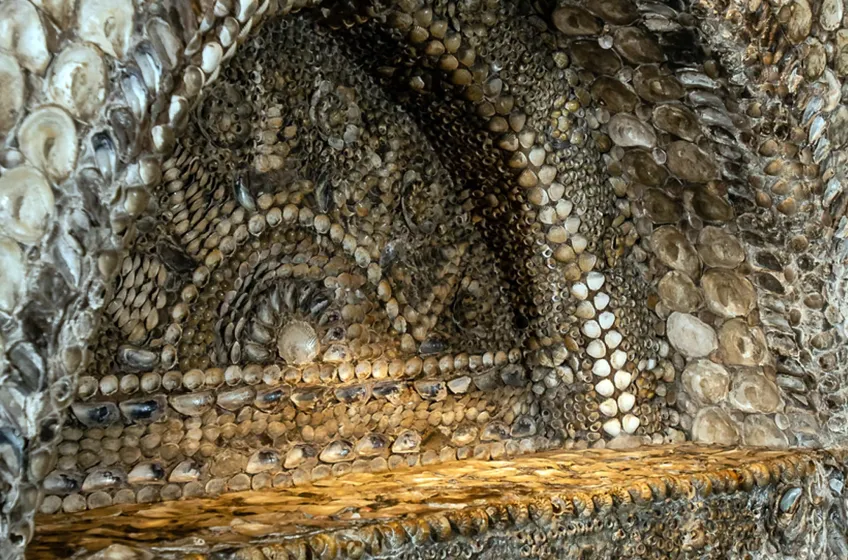
The grotto’s passages, totalling around 70 feet in length, are covered with shell mosaics in geometric and figurative designs. Patterns include spirals, sunbursts, stars and floral motifs. Some appear abstract, while others resemble symbols or hieroglyphs. The mosaics are made almost entirely of locally sourced shells, though some marine materials are thought to have come from further afield.
The Rotunda
At the heart of the grotto lies a domed chamber known as the Rotunda. Here, the walls are lined with shell mosaics arranged in radial patterns, and a small skylight above allows natural light to filter in. This space is often seen as the most atmospheric part of the grotto and adds to theories that the site may have had ceremonial or symbolic use.
The Altar Chamber
One of the most striking areas is the so-called Altar Chamber, named for a central ledge or niche that resembles an altar. The mosaics here include more elaborate designs, and the chamber’s name has fuelled speculation about religious or ritualistic purposes. Whether this interpretation is accurate remains unknown, but it is a focal point for visitors exploring the grotto.
The Shell Grotto shop
Above ground, the site includes a shop offering a wide range of shell-themed gifts, crafts and books. The shop also stocks local artisan products, making it a popular place for souvenirs. Many of the items reflect the themes of the grotto, from shell jewellery to decorative pieces.
The Shell Grotto café
The attraction includes a small café where visitors can enjoy drinks and light snacks. Its interior is decorated with shells and references to the grotto, creating a link between the underground chambers and the visitor experience above ground.
Interpretive displays
Though the grotto’s origins remain uncertain, interpretive panels and displays present the various theories that have been put forward, from Phoenician temple to Victorian eccentricity. These displays also provide details about the techniques used to conserve and protect the fragile mosaics.
Nearby attractions
The Shell Grotto is located a short walk from Margate town centre and complements several of the area’s other attractions. Turner Contemporary, on the seafront, provides a striking contrast as a modern art gallery, while Dreamland amusement park offers a lively retro seaside experience.
Margate Old Town is nearby, with independent shops, vintage boutiques, galleries and cafés clustered in historic streets. For those interested in local history, Margate Museum provides further context on the town’s maritime past and development as a seaside resort.
The beach at Margate Main Sands is within easy reach, offering the opportunity to combine a visit to the grotto with time by the sea. Further afield, Broadstairs and Ramsgate provide additional coastal attractions and historic sites.
Practical advice for visitors
The Shell Grotto is located on Grotto Hill, about ten minutes’ walk from Margate railway station and close to the Old Town. It is signposted locally, though its modest entrance means it is easy to miss without directions.
The grotto is open most of the year, though opening hours vary seasonally, so visitors should check ahead on the official website. There is an admission charge, with concessions available for children, students and families. Entry tickets support the ongoing conservation of the site.
Due to the nature of the grotto, the underground passages are narrow and uneven underfoot. Comfortable shoes are recommended, and visitors should be aware that it may not be fully accessible for those with mobility issues or pushchairs. The interior is also dimly lit, adding to the atmosphere but requiring care when moving around.
Photography is permitted, but flash is discouraged to protect the fragile surfaces. The constant humidity inside the grotto makes it essential to maintain careful conservation measures, so visitors are asked not to touch the mosaics.
As the attraction is relatively small, a typical visit lasts around 30–45 minutes, though time can be extended with a stop at the café or shop. It can be easily combined with a wider day out in Margate, making it an excellent addition to an itinerary that includes the beach, Turner Contemporary or Dreamland.
Shortlist
- Your Shortlist is empty