
A Visitor's Introduction to The British Library
The British Library, located in London, is the national library of the United Kingdom and one of the most significant research libraries in the world. Situated adjacent to St Pancras International and King’s Cross stations, it holds more than 170 million items from every age of written civilisation. The collection includes manuscripts, books, newspapers, maps, sound recordings, patents, prints and drawings, and a wealth of digital content. Open to the public, with free exhibitions, reading rooms, and research services, the library serves as a vital institution for scholars, students, and general visitors interested in history, literature, and culture.
Established in its current form in 1973, following the British Library Act, it inherited collections from institutions such as the British Museum Library and the National Central Library. The current building, opened in 1998, is the largest public building constructed in the UK during the 20th century and was designed by architect Sir Colin St John Wilson. The library’s extensive collections and welcoming public spaces make it a distinctive part of London’s cultural infrastructure.
Recommended St. Pamcras accommodation: Hotels
Pre-book London Attractions, Tours & Experiences
Why is The British Library Worth a Visit?
The British Library offers a unique combination of cultural heritage, academic resource, and public exhibition space. Visitors can view original manuscripts by historical figures such as Leonardo da Vinci, William Shakespeare, Jane Austen, and Charles Dickens. The Treasures Gallery, a permanent exhibition space, showcases iconic documents including Magna Carta, the Lindisfarne Gospels, and handwritten lyrics by The Beatles.
The library's role as a legal deposit institution ensures it receives a copy of every publication produced in the UK and Ireland, meaning it holds both historic volumes and contemporary material. This makes it a living archive that evolves constantly and remains relevant for research and general interest alike.
Beyond exhibitions, the British Library regularly hosts talks, panel discussions, workshops, and film screenings. It provides an environment that is both contemplative and interactive, with reading rooms open to anyone who registers for a reader pass. Whether you are interested in viewing rare literary works, conducting academic research, or simply exploring an institution that plays a vital role in preserving cultural memory, the British Library offers considerable value to visitors.
Highlights of the British Library
The Treasures Gallery
One of the most popular parts of the library is the free-to-enter Treasures Gallery. This permanent exhibition displays a curated selection of rare and historically important items from the library’s vast collection. Highlights include original medieval manuscripts, religious texts such as the Gutenberg Bible and Qur’an fragments from the 8th century, and handwritten notes by iconic figures such as Virginia Woolf and Florence Nightingale. The gallery is organised thematically, with sections dedicated to literature, music, religion, politics, and science.
Magna Carta
The British Library holds two of the four surviving copies of the original 1215 Magna Carta. This foundational document in English legal history is displayed periodically, often with contextual exhibitions that explore its significance. When on view, it is typically accompanied by interpretive materials that explain its historical context and legal legacy.
The King’s Library Tower
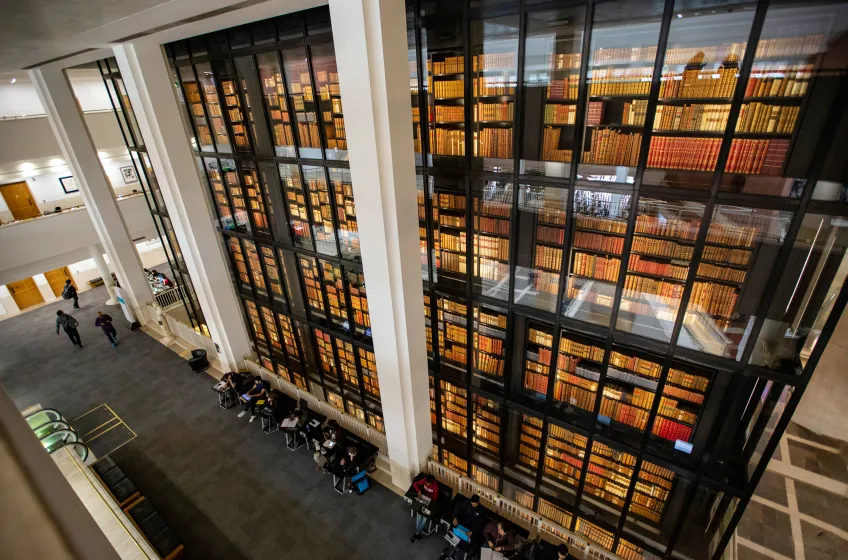
At the heart of the building is a striking six-storey glass tower housing the King’s Library, a collection of over 65,000 printed volumes and pamphlets assembled by King George III. This central feature of the library serves both as a functional archive and an architectural centrepiece. Visitors can view the books through the transparent panels, offering a visual sense of the scale and diversity of the historic collection.
Reading Rooms
The British Library contains several reading rooms, each dedicated to a specific area of study such as humanities, social sciences, business, and maps. Access is free, although users must register for a reader pass. The reading rooms are designed for quiet study and are used daily by researchers, students, and writers. Specialist staff are available to assist with accessing materials and navigating the library's extensive catalogues.
Temporary Exhibitions
In addition to the permanent collections, the library hosts temporary exhibitions that explore a wide range of topics including literature, history, politics, and global culture. These exhibitions often include rare loans from other institutions and private collections, and are supported by detailed interpretation, audio-visual material, and interactive displays. Past exhibitions have included subjects such as Harry Potter, the history of maps, punk music, and the life of Karl Marx.
Sound Archive
The British Library Sound Archive is one of the largest in the world, with over 6.5 million recordings. It includes everything from oral histories and wildlife sounds to classical music and radio broadcasts. Selections from the archive are often featured in exhibitions and can also be accessed digitally or through on-site listening stations.
Maps and Atlases
The library’s map collection is one of the most comprehensive globally, with more than 4.5 million items, including atlases, sea charts, and large-scale printed maps. While not all are on public display, special exhibitions and consultations allow visitors to explore geographic history and cartographic design. The collection spans from the 14th century to the present day.
Business & IP Centre
A lesser-known aspect of the library is its Business & Intellectual Property Centre (BIPC), which supports entrepreneurs, inventors, and small businesses. It offers free access to market research databases, company data, and intellectual property guidance, alongside workshops and one-to-one advice sessions. This service makes the British Library an essential resource for innovation and enterprise as well as culture and history.
Piazza and Outdoor Spaces
The British Library features a large outdoor piazza with a sculpture of Sir Isaac Newton by Eduardo Paolozzi. The space is often used for open-air events, pop-up exhibitions, and installations. It also serves as a peaceful place to relax, especially during the summer months.
Cafés and Restaurants
There are multiple dining options within the library, including the Kings Library Café, the Terrace Restaurant, and pop-up vendors. These spaces provide refreshments for both casual visitors and long-term researchers, offering light meals, coffee, and snacks throughout the day.
Bookshop
The British Library’s shop offers a wide range of books, gifts, and exhibition merchandise. The selection often reflects current exhibitions and permanent collections, making it a good place to find themed publications, high-quality prints, and unique souvenirs.
Nearby Attractions
The British Library is well positioned for exploring other prominent attractions in London. A short walk away is St Pancras International Station, itself an architectural landmark and home to the St Pancras Renaissance Hotel. The neighbouring King’s Cross Station is famous for the fictional Platform 9¾ from the Harry Potter series, complete with a photo opportunity and themed shop.
Nearby is the Wellcome Collection, a free museum and library exploring health, medicine, and human experience through art and science. Just beyond is the Charles Dickens Museum, located in the writer’s former home on Doughty Street, offering insights into his life and works.
To the south lies The British Museum, another world-leading institution with collections covering global history and archaeology. Within walking distance are Regent’s Canal, with scenic towpaths and boat tours, and Coal Drops Yard, a shopping and dining area in a converted Victorian coal yard offering boutiques, restaurants, and open-air installations.
Practical Advice for Visitors
The British Library is open to the public seven days a week, though opening hours vary slightly between weekdays and weekends. Entrance to the building and the permanent Treasures Gallery is free. Temporary exhibitions usually require a paid ticket, which can be booked online in advance or purchased on the day, subject to availability.
The library is fully accessible, with step-free access, lifts, accessible toilets, and assistance available for those with additional needs. Reading rooms require registration for a free reader pass, which involves providing identification and proof of address. The process can be completed on the same day, although it is advisable to check the library’s website for full requirements.
Photography is allowed in some public areas but is restricted in reading rooms and certain exhibitions. Wi-Fi is free throughout the building, and lockers are available for storing bags, which may be required when accessing reading rooms.
The library is located in Zone 1 of the London Underground, easily reached by King’s Cross St Pancras station, which is served by multiple tube lines and national rail services. Buses, cycling routes, and nearby Santander Cycle stations also provide convenient transport options.
Security checks are in place at the entrance, and visitors may experience a short wait during busy periods. Planning ahead—especially when attending ticketed exhibitions or research appointments—can ensure a smooth experience.
For those planning extended visits, the library’s proximity to other museums, shops, parks, and transport hubs makes it a convenient and enriching stop during any trip to London.
Shortlist
- Your Shortlist is empty